
play_arrow
Listeners:
Top listeners:
00:00
00:00
volume_up
chevron_left
-
 play_arrow
123 | A Science Paradox: Would Francis Bacon Have Survived Greenpeace and Exxon?
-
 play_arrow
122 | How Climate Solutions Lost the Megaphone — and How to Take It Back, with Reverend Dr. Gerald Durley
-
 play_arrow
121 | Michael Greene: Carbon Cowboy or Lone Ranger Part 2 – The $200 Million Land Heist in the Amazon
-
 play_arrow
120 | Indonesia is Still Moving its Capitol, and Nobody Cares?
-
 play_arrow
118 | Kenyan Herders Say Judgement Against Them Based on Forged Signatures / Continuation of Episode 117
-
 play_arrow
117 | Surviving Survival Internatinal, Part 1: Kenyan Elders Call Foul on International Media, NGOs
-
 play_arrow
116 | From Ticking Time Bomb to Demographic Dividend: James Mwangi and Kenya's Great Carbon Valley
-
 play_arrow
115 | Unpacking Donald Trump's Very Weird Environmental Orders
-
 play_arrow
114 | Michael Greene: Carbon Cowboy or Lone Ranger? Part 1
-
 play_arrow
113 | The Future of Environmental Finance: Strategies for Biodiversity and Climate Solutions, with David Hill and George Kelly
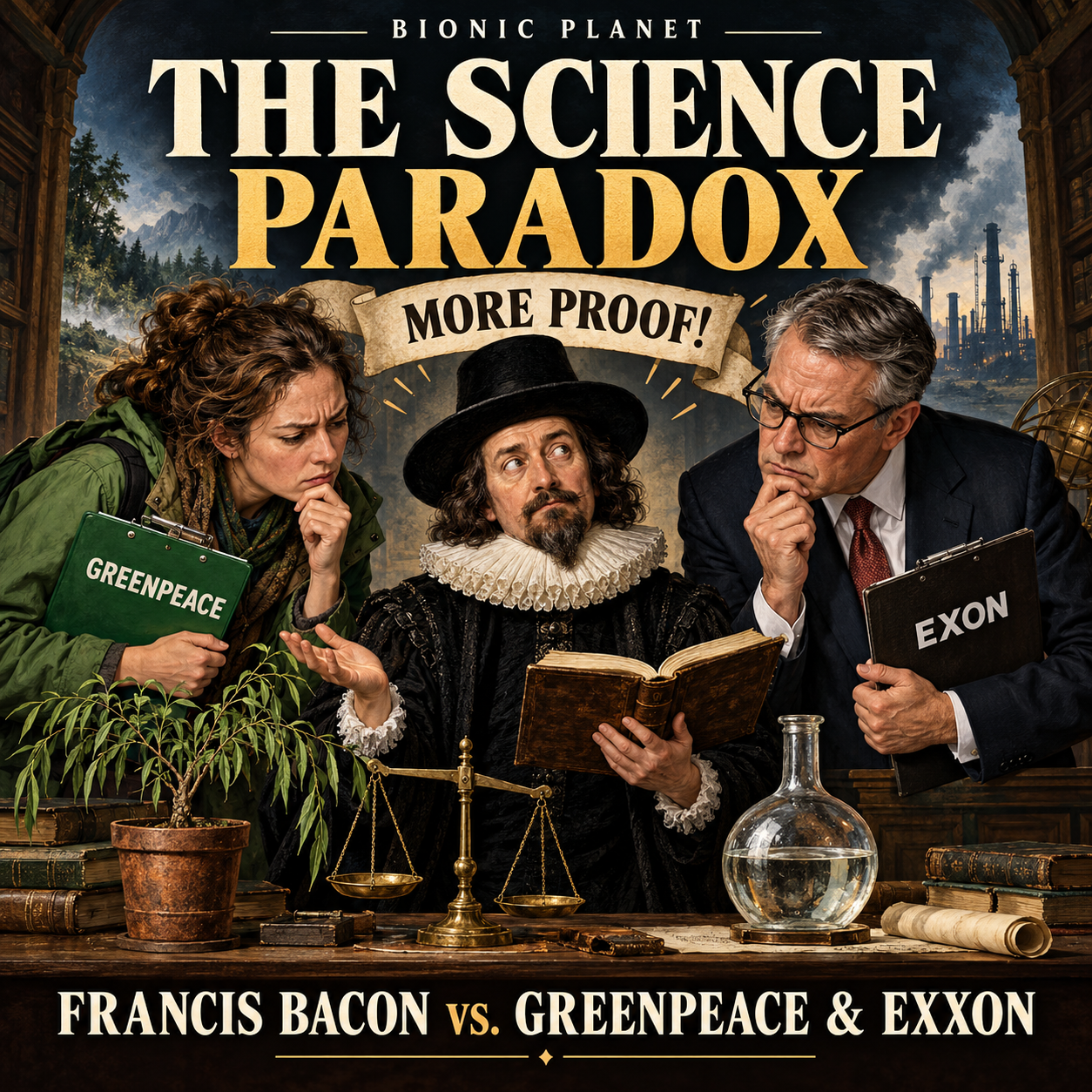
123 | A Science Paradox: Would Francis Bacon Have Survived Greenpeace and Exxon?
-
play_arrow
PLAY EPISODE
Transcript arrow_drop_down

Transcript
A tree grows out of the ground. But does it come from the ground?
Four hundred years ago, Jean-Baptiste van Helmont planted a willow tree in a carefully weighed pot of soil to find out. His experiment produced evidence he couldn’t fully explain—and helped open a trail of discovery connecting forests, fuels, and the atmosphere.
In this episode of Bionic Planet, I revisit the prehistory of the voluntary carbon market, from the ancient Greeks’ four elements to Francis Bacon’s assault on dogma and the experiments that helped turn alchemy into chemistry.
Along the way, we meet people who got the experiment right and the explanation wrong, discovered gases they couldn’t identify, and challenged theories that had seemed to explain everything.
Their stories bring us to two recurring themes on Bionic Planet: the science behind climate change and the challenge of acting under uncertainty.
Right-wing climate science deniers exploit uncertainty to undermine trust in climate science. Left-wing opponents of carbon markets exploit it to undermine trust in climate solutions. The targets differ, but the maneuver is familiar: turn the limits of knowledge into an excuse to dismiss what we do know.
In The Carbon Paradox, my co-authors and I explore a related dilemma we call the Science Paradox: methods improve, evidence accumulates, and yesterday’s best practices can become tomorrow’s targets. Waiting for the perfect methodology means waiting forever—while the forests we’re trying to protect disappear.
This episode explores:
-
Francis Bacon’s challenge to dogma, bias, and distorted public discourse.
-
Van Helmont’s willow experiment and the mystery of where trees get their mass.
-
Joseph Black’s “fixed air,” now known as carbon dioxide.
-
Phlogiston, Joseph Priestley, and Antoine Lavoisier’s competing explanations of combustion.
-
Jan Ingenhousz and the role of sunlight in photosynthesis.
-
The connection between Black’s work on latent heat, steam engines, and modern heat pumps.
Read further
-
The Carbon Paradox, by Renat Heuberger, Steve Zwick, and Marco Hirsbrunner—a story of three young idealists confronting the practical and political contradictions of climate finance.
-
Novum Organum, by Francis Bacon—free to read through Project Gutenberg.
-
The Life and Letters of Joseph Black, M.D., by William Ramsay.
-
Lavoisier in the Year One, by Madison Smartt Bell.
Help support independent reporting on climate and biodiversity finance: become a Bionic Planet patron.
For sponsorship inquiries, contact steve@bionic-planet.com.
-
play_arrow
123 | A Science Paradox: Would Francis Bacon Have Survived Greenpeace and Exxon? Steve Zwick
Podcast: Play in new window | Download
Episodes

play_arrow
play_arrow


play_arrow